
Single Wide vs Double Wide: What Changes When You Move One
Guides · Green Mobile Home Transport · July 11, 2026
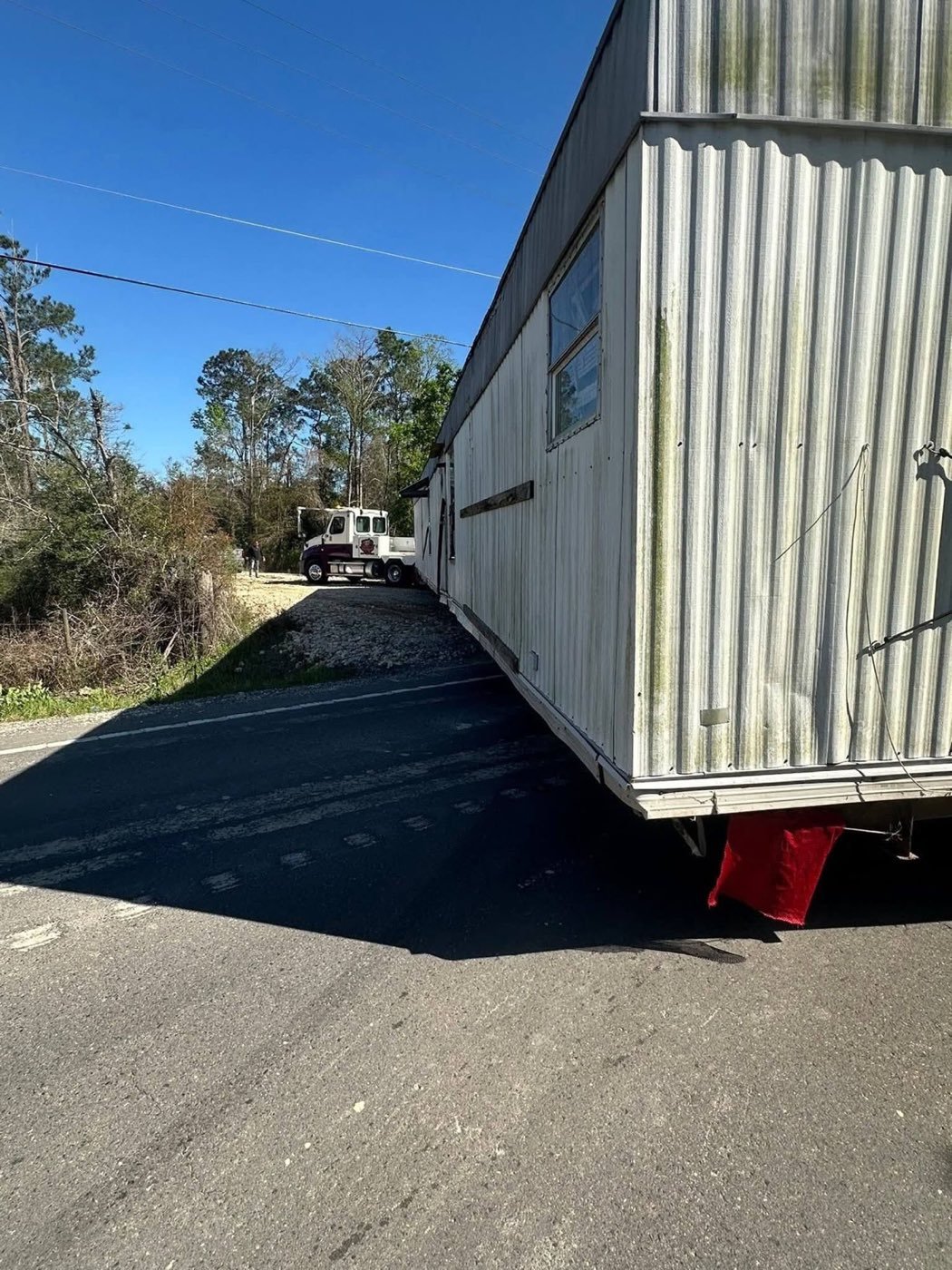
Most people price a double wide as a single wide with a bit extra on top. It is not. A double wide is two separate oversize movements plus a joinery job in the middle, and almost every difference that matters — permits, escorts, days on site, whether the home is weathertight afterward — follows from that fact. A single wide is one body on one trip. A double wide is two bodies that have to be made into one house again at the far end.
1. What makes a home a single wide
A single wide is one continuous unit on one chassis. Bodies typically run 14 to 18 feet wide and 50 to 90 feet long, and the home travels as a single load behind one toter, on one permit set in each jurisdiction it crosses.
Simpler, but not simple. The federal width standard on the National Network is 102 inches — 8 feet 6 inches — and states permit anything wider (23 CFR 658.15, 658.17). A 14-foot body is well over that before the eaves, so there is no unpermitted mobile home move and no “it is my own house” exemption.
2. What makes a double wide different, and it is not only the width
A double wide is two independently chassised halves, each commonly 14 to 16 feet wide, bolted and sealed to each other along the marriage line. The home was assembled on site the first time and has to be disassembled and reassembled every time it moves: separated at the origin, hauled on two trips, re-joined at the destination.
Triple wides and larger multi-section homes are the same logic with more of it: three sections or more, two marriage lines or more, three permitted movements or more. Nothing below changes in kind; it just happens again.
3. Permits and escorts double, they do not simply increase
Each section is its own oversize movement: its own permit in every state, county and municipality the route touches, its own approved route, travel window and escort booking. Two halves on the same road on the same morning are still two permitted moves, and Texas is explicit that a manufactured home needs a permit per half moving on its own axles.
Width is what triggers the escort, and the threshold is state law rather than a national rule. Twelve feet is the most common first trigger: Maine’s manufactured-home table runs one pilot vehicle above 12 feet, two above 14 feet 6 inches and police escorts at 16 feet, while Utah counts eaves over 12 inches toward the measured width.
Which is where double wides get expensive: a 16-foot half can sit in a worse escort bracket than a 14-foot single wide on the same road, and you pay twice. Thresholds and authorities vary by state — our state pages name the office for each, permit assistance is part of the quote, and the detail is in the permits guide.
4. Teardown: what has to come apart on a double wide
On a single wide, teardown is skirting, steps, decks, awnings, anchors and blocking, then hitch and running gear. A double wide gets all of that plus the marriage line, which is a structural and weather joint rather than a seam.
- Structural fasteners along the marriage wall — the bolts and lag connections tying the halves into one structure, out without wrecking the holes they go back into.
- Roof cap and ridge — the cap bridging the two roof planes, which on an older home is frequently not reusable.
- Endwall and floor seals — gaskets and sealant along the full length of the joint, top to bottom.
- Interior finish across the line — flooring transitions, ceiling and wall finishes installed across the joint after the home was first married.
- Crossovers — the duct, water, drain and electrical connections running between the halves, disconnected and capped.
None of that exists on a single wide, and every item has to be re-done at the far end. Which is why double wide labor is not twice single wide labor. It is more.
5. The haul itself: one trip or two
A local single wide move is usually one toter day: hitch, haul, drop. A double wide is two hauls, and on a long route the halves may travel on different days with a staging yard between.
Which raises the thing nobody mentions in a quote: for part of that window one half of your house sits open to the weather under a temporary cover. Good sequencing means the halves land close together and the home closes up fast. Bad sequencing means a week of rain blowing into an open wall. If a quote does not say how the sections are sequenced, ask.
Running gear scales too, and the rules are real: Washington requires at least four axles on any housing unit over 14 feet wide. A double wide is therefore two complete sets of roadworthy axles, hubs, springs and tires.
6. Setting it: the marriage line is the whole job
This is where a double wide is won or lost, and it is the part a homeowner cannot see from outside.
Both halves have to be blocked and leveled to each other across the line, not merely each level in isolation. Two halves can each read level alone and still sit a quarter inch apart at the joint, and that quarter inch is what you feel for twenty years. Then the sections are drawn tight, structurally interconnected to the manufacturer’s instructions, and closed up inside and out — three distinct operations in the federal standards (24 CFR 3285.801, 3285.802, 3285.803).
Done badly, the symptoms all show up down the center of the home: a draft along the middle of the house, a line in the ceiling, drywall cracking at the joint, doors near the marriage wall that will not latch, a ridge that leaks within two winters. A single wide cannot fail in any of those ways. See leveling and setup and installation.
7. The crossovers almost nobody checks
A double wide has heating ducts, water lines, drains and electrical circuits crossing between the halves. A single wide has none, because there is nothing to cross to. They are also the most common defect we find under a re-set double wide, and invisible unless somebody goes underneath with a light.
The federal standards are specific. Duct crossovers must be sealed against air leakage with listed tape or mastic, fastened with at least three screws around the collar, and insulated anywhere outside the thermal envelope (24 CFR 3285.606). Water crossovers must be protected from freezing and the system tested for leaks (3285.603). Electrical crossovers are completed to the home’s own instructions (3285.701).
In practice the failures are mundane: a flex duct never reconnected, so half the house gets no heat; an uninsulated crossover that condenses and rots the floor above it; a water line reconnected but not protected, which you find out in January. What a proper setup involves has the sequence.
8. Blocking and anchoring: more piers, more anchors
Pier count scales with length, with weight, and with the marriage line, which generally needs its own pier line along the marriage beam plus extra support under marriage-wall openings where the manual calls for it. Anchor count scales with section count and the destination’s wind zone.
We will not give you a count here, because an honest one does not exist in the abstract: the home’s own installation manual governs, and where it is long gone the installer works to the federal Model Manufactured Home Installation Standards (24 CFR Part 3285). What is fixed is the hardware — anchoring equipment has to carry a 3,150-pound working load and withstand a 50 percent overload to 4,725 pounds without failing (24 CFR 3285.402). See anchors and tie-downs.
9. Re-leveling: a double wide drifts differently
Every home settles. A single wide settles as one object: the piers under one end take up a little, the floor slopes, you shim it. A double wide settles as two objects joined at a seam, and the seam shows it first — a hairline crack at the ceiling joint, a gap at a door casing near the middle, a floor that feels like a shallow valley down the center. Catch it there and it is a shimming job; ignore it and you are re-sealing a roof ridge too. On a double wide the level check starts at the line.
10. What it costs, and why
Transport roughly doubles, because it is two permitted movements with two sets of running gear. Setup more than doubles, because the marriage line and the crossovers are work with no single wide equivalent.
No ranges here, because a number without its assumptions is worse than no number. What it costs to move a mobile home breaks it out by section count and distance; the cheapest way to move a mobile home covers where you can genuinely save. When you compare quotes, the marriage line and the crossovers should be their own line items — otherwise the quote has either absorbed them or excluded them, and you cannot tell which.
11. Timeline: how many days each actually takes
Crew time, not calendar time — permit and escort lead time sits in front of both. A local single wide is realistically one to two days on site. A local double wide is three to five: separating the halves is a job in itself, there are two hauls, and the marriage line and crossovers are a day of their own. Add days for a long route, an uncured pad, or a state with narrow travel windows.
12. Which one are you moving? How to tell
- Look for the seam — stand at the end of the home. A double wide has a visible joint down the center of the roof and usually a matching line in the ceiling inside.
- Find the data plate and the HUD labels — the plate inside names the manufacturer, serial number and the wind, roof load and thermal zones; the metal label is on the exterior. Each section carries one of each.
- Count the titles — in many states each section of a multi-section home is separately titled, which matters for permitting. Check what your state does rather than assuming.
- Measure, do not estimate — wall to wall, then again over the eaves, because some states measure width with the eaves in.
Photograph both and send them with your inquiry. It is the difference between a real quote and a guess.
The short version
A double wide is not a wider single wide. It is two permitted oversize movements, two sets of running gear and a joinery job in the middle — and the joinery is the part you live inside afterward. The haul is the half everybody prices. The marriage line is the half that decides whether the house is any good when it lands.
So: count the sections. Measure the width wall to wall and again over the eaves. Find the data plate and HUD label on every section, and check whether your state titles each separately. Ask any quote to itemize the marriage line and the crossovers, and ask how the halves will be sequenced.
Send us both addresses and the section count: get a free written quote, read how mobile home transport works, or go to what a move costs.